
Orthodontics
- Home
- Orthodontics
Orthodontics in Baku — braces and clear aligner treatment
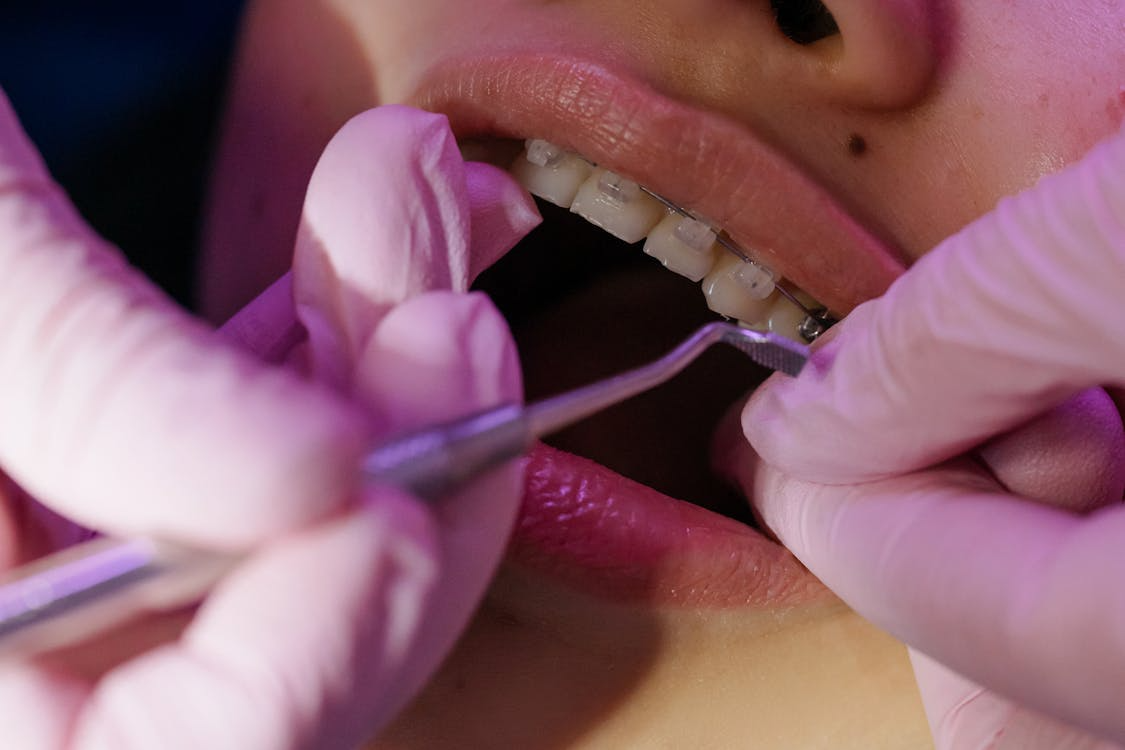
Orthodontics is the branch of dentistry concerned with tooth position and bite correction. At German Dental Clinic orthodontic treatment starts with digital diagnostics: working from a 3D scan, a cephalometric x-ray and a photo protocol, the dentist plans in advance the order in which the teeth will move.
What an orthodontist does
An orthodontist does more than straighten teeth. The job is to balance how the dental arches, the jaws and the chewing muscles work together. A correct bite lets food be chewed properly, keeps individual teeth from being overloaded and makes hygiene easier — a brush cannot reach fully between crowded teeth, so decay starts there sooner.
When orthodontic treatment is needed
- crowding, irregular or rotated teeth;
- gaps between teeth (diastema, spacing);
- deep, open or crossbite;
- a mismatch between the upper and lower jaw;
- a gap narrowing after the early loss of a primary tooth;
- preparing space for a bridge or an implant;
- discomfort when chewing, clicking or tension in the jaw joint.
Treatment stages
- Consultation and diagnostics. Examination, digital scan, panoramic and cephalometric x-rays, photo protocol.
- Treatment plan. The dentist goes through the available options — braces, aligners or a combined approach — with timelines and stages.
- Preparation. Decay is treated and professional hygiene is carried out before any appliance is fitted.
- Active phase. With braces, an adjustment every 4–8 weeks; with aligners, a new tray every 7–14 days.
- Retention. Once the appliance comes off, a retainer holds the result in place.
Types of braces
- Metal braces — the strongest system with the widest range of movement, chosen for complex cases.
- Ceramic braces — close to tooth colour and barely visible at conversational distance.
- Sapphire braces — transparent, they transmit light and stand out less on light teeth.
- Lingual braces — bonded to the inner surface of the teeth and invisible from the outside.
- Self-ligating systems — they work without elastic ligatures, so review visits are usually spaced further apart.
Which system suits you is decided by the complexity of the case, your hygiene habits and your aesthetic expectations together.
Braces or clear aligners
Aligners are removable transparent trays: they come out for meals and brushing and must be worn 20–22 hours a day. They are a comfortable solution for mild and moderate cases, particularly for adults who cannot wear visible braces for aesthetic or professional reasons. Where the bite problem is complex, or a tooth must be moved a long way together with its root, braces can do more.
How long treatment takes
Mild cases usually take 6–12 months, moderate and complex ones 18–30 months. The timeline depends on the complexity of the case, age, the condition of the bone and how closely the instructions are followed. An exact figure is given after diagnostics, together with the treatment plan.
Retention — holding the result
After the appliance is removed the teeth still tend to drift back towards their old position for a while. That is why the final stage of treatment is a retainer: a thin wire bonded behind the teeth or a clear tray worn at night. Skipping retention can undo the result of the active phase over the following years.
Orthodontics for children and teenagers
The best age for a first orthodontic check-up is 7–8: permanent teeth are starting to come through and jaw growth can still be guided. At this early stage removable plates and trainers are often enough, while a full fixed appliance is usually placed once all permanent teeth have erupted.
Frequently asked questions
Does fitting braces hurt?
Bonding the brackets is painless. For the first 2–3 days and after each adjustment you feel pressure and mild discomfort — a sign the teeth are moving, and it passes within a few days.
Can teeth be straightened as an adult?
Yes. Teeth move at any age as long as the gums and the supporting bone are healthy. Treatment may run longer in adults, but the result is achieved on the same principle.
What should not be eaten with braces?
Hard food (nuts, ice, hard crackers) and sticky sweets pull the brackets off. Apples and carrots simply need to be cut into pieces.
How often are orthodontic visits needed?
With braces usually every 4–8 weeks, with aligners every 6–8 weeks.
See also: Clear aligners · Gnathology: TMJ and bruxism · Types of braces: metal, ceramic, zirconia, lingual · Braces or clear aligners · Retainers after braces · How to choose an orthodontist
Book a consultation — after diagnostics the dentist will propose a suitable system, timeline and treatment stages.