
Hygiene
- Home
- Hygiene
Professional dental hygiene in Baku — cleaning and prevention
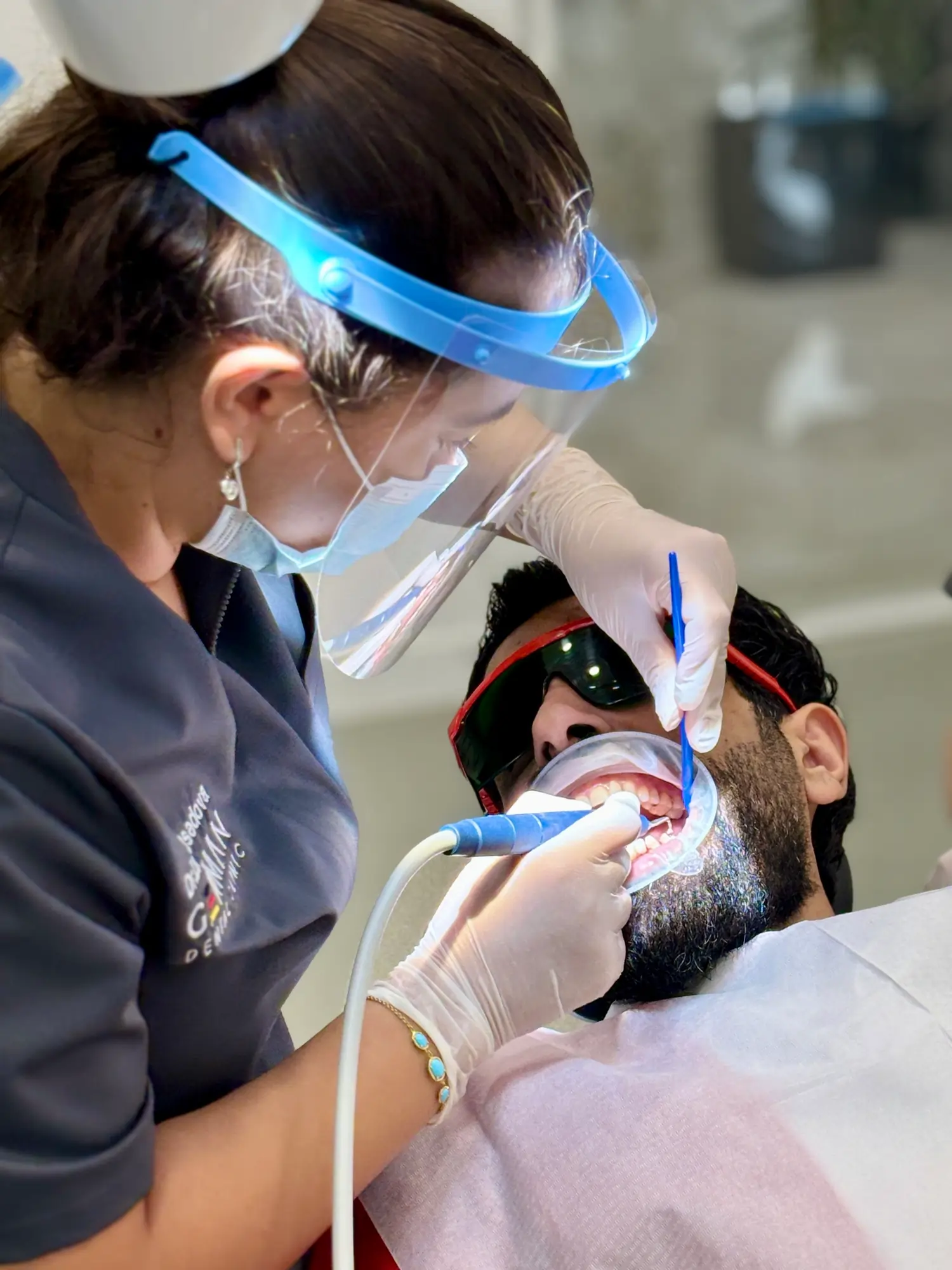
Professional hygiene cleans what a toothbrush cannot reach: the area under the gum margin, the spaces between teeth and hardened calculus. It is the simplest and most effective step in preventing decay and periodontitis — and an examination that often finds a problem before any pain starts.
How the appointment goes
- Examination. The condition of the gums, the amount of plaque and the problem areas are assessed.
- Ultrasonic scaling. Calculus is removed by vibration above and below the gum margin.
- AirFlow. A jet of fine powder and water lifts stained plaque from tea, coffee and smoking.
- Polishing. The enamel surface is smoothed — plaque settles more slowly on a smooth surface.
- Fluoride application. A varnish or gel that strengthens enamel and reduces sensitivity.
- Advice. An individual choice of brush, paste, interdental aids and technique.
The appointment usually takes 40–60 minutes and can be combined with a check-up in the same visit.
When to come in
- your gums bleed when brushing;
- calculus is visible above or below the gumline;
- persistent bad breath;
- teeth have discoloured from tea, coffee or smoking;
- before orthodontic treatment and while wearing braces;
- as preparation before implants, prosthetics or whitening.
How often it is needed
Once or twice a year suits most patients. With diagnosed periodontitis, for smokers, for people wearing braces or implants and in diabetes, the interval shortens to every 3–4 months. The exact schedule is set at the first visit according to how fast plaque builds up.
Ultrasonic, AirFlow and polishing are different steps
Ultrasonic scaling removes hard calculus; AirFlow removes stained plaque and biofilm rather than calculus — they do not replace each other, they are consecutive steps of one protocol. Polishing then smooths the cleaned surface. Calculus cannot be removed at home with whitening toothpaste and a hard brush: those only abrade enamel and exposed root surface.
Does hygiene whiten teeth
Professional cleaning returns teeth to their own colour, because the stained deposit on top is removed. That is not whitening: the natural shade of the enamel does not change. Whitening is a separate procedure and is always done after hygiene, since the gel only acts evenly on a clean surface.
Daily hygiene at home
- twice a day for 2 minutes, with fluoride toothpaste;
- floss or interdental brushes every day;
- replace the brush every 3 months and after any illness;
- do not rinse with water right after brushing — let the fluoride keep working;
- wait 30 minutes after acidic food or drinks before brushing.
Which brush, paste and interdental aid
A soft-bristled brush suits most patients: a hard brush does not remove plaque any better, but it pushes the gum back and abrades exposed root surface. An electric brush, especially a model with a pressure sensor, helps keep the technique consistent. In toothpaste the figure that matters is the fluoride content; highly abrasive whitening pastes are not meant for daily use. The interdental aid is chosen by the size of the gap: floss where contacts are tight, and an interdental brush where the gap is wider or where there are braces, bridges or implants.
Staining from coffee, tea and smoking
Tea, coffee, red wine and smoking leave a stained layer on the enamel surface, and smoking also makes plaque harden faster. That layer cannot be removed at home with toothpaste — it comes off at the AirFlow stage. This is exactly why the interval between visits is shorter for smokers.
Frequently asked questions
Is professional cleaning painful?
With healthy gums the procedure is painless. Where there is inflammation or exposed roots there may be sensitivity — an anaesthetic gel or local anaesthetic is used in that case.
Does ultrasonic scaling damage enamel?
Used correctly it does not: the tip breaks up the structure of the calculus rather than cutting enamel. Damage more often comes from scrubbing at home with a hard brush and abrasive paste.
Why are teeth sensitive after a cleaning?
Root surface that was covered by calculus becomes exposed and can react to cold for a few days. Fluoride paste and varnish shorten that period.
Can hygiene be done with braces?
Yes, and it matters more: plaque accumulates faster around brackets. People wearing braces are usually advised to have a cleaning every 3–4 months.
See also: Tartar removal: when and how · Correct brushing technique · Bad breath · Tooth sensitivity · Periodontal treatment
Book a hygiene appointment — the dentist will examine you in the same visit and set a review schedule that fits you.